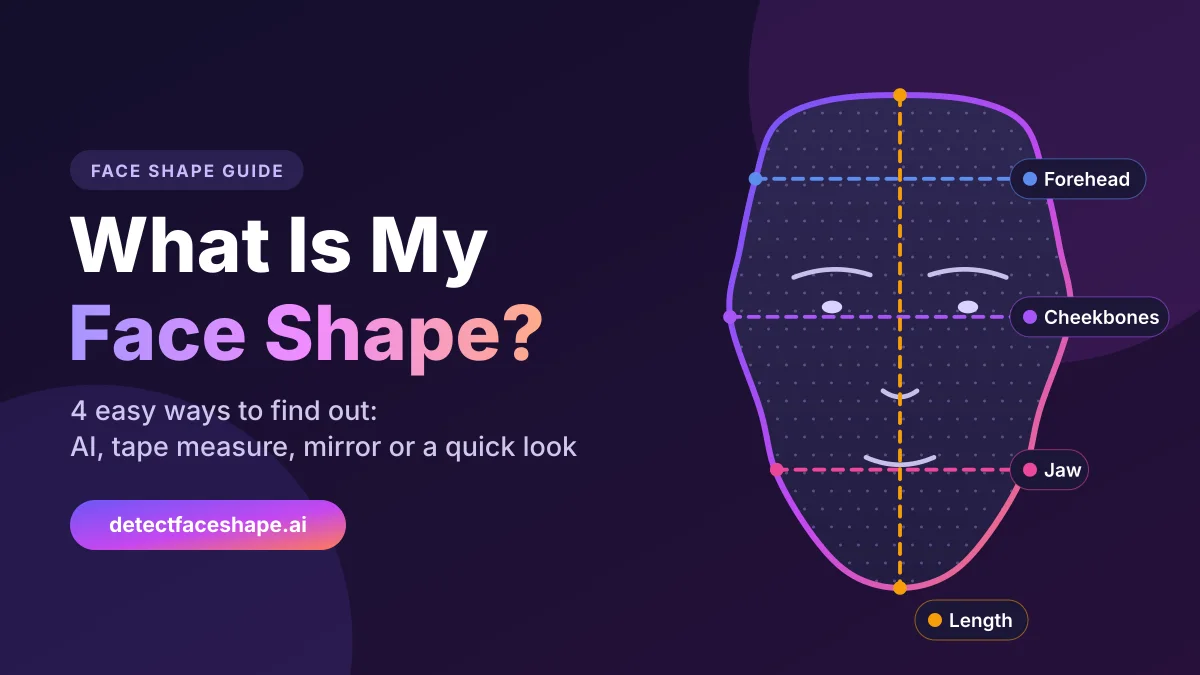
“What is my face shape?” is the first question to answer before choosing a new haircut, a pair of glasses or a beard style. The good news: you do not need a stylist to answer it. In this guide you will learn what a face shape is, how to find yours in four easy ways, and how to avoid the mistakes that lead to the wrong result.
What Is a Face Shape?
A face shape is the outline of your face from hairline to chin, seen from the front. It comes from your bone structure, not your weight or skin, which is why two people with similar features can have different face shapes.
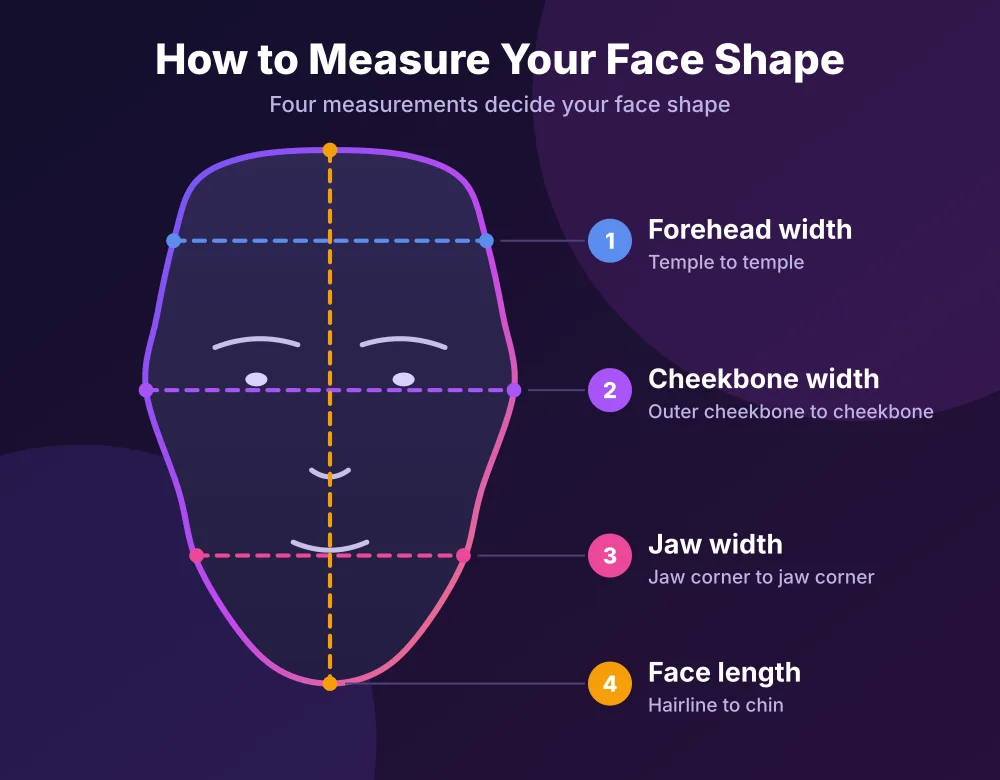
Every face shape is decided by four measurements:
- Forehead width: across the widest part of your forehead, from temple to temple.
- Cheekbone width: between the outer points of your cheekbones, just below the outer corners of your eyes.
- Jaw width: from the corner of your jaw below one ear to the same point on the other side.
- Face length: from the center of your hairline straight down to the tip of your chin.
Two details then separate similar shapes: whether your jawline is soft or angular, and whether your chin is rounded, square or pointed.
The 8 Face Shapes Explained
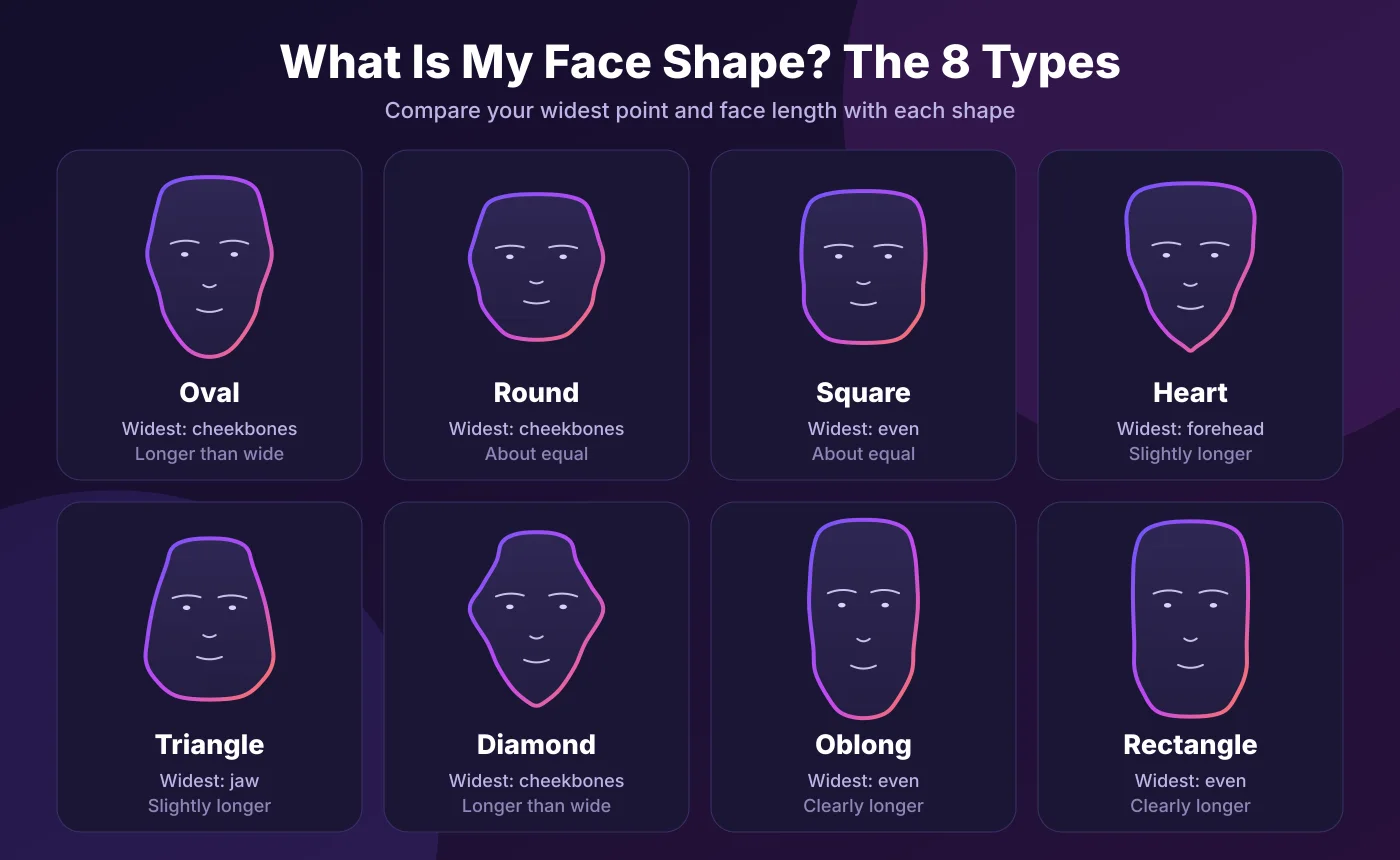
There are eight face shapes: oval, round, square, heart, triangle, diamond, oblong and rectangle. Use this chart to compare them with your own face.
| Face shape | Length vs width | Widest point | Jawline | Chin |
|---|---|---|---|---|
| Oval | Longer than wide | Cheekbones | Soft, slightly narrower than the forehead | Gently rounded |
| Round | About equal | Cheekbones | Soft and curved | Rounded |
| Square | About equal | Even all the way | Strong and angular | Flat or square |
| Heart | Slightly longer | Forehead | Narrows toward the chin | Pointed |
| Triangle | Slightly longer | Jaw | Wide and strong | Broad |
| Diamond | Longer than wide | Cheekbones | Narrow | Pointed |
| Oblong | Clearly longer | Even all the way | Soft | Rounded |
| Rectangle | Clearly longer | Even all the way | Angular | Square |
Each shape has its own strengths. Our face shapes guide explains every one in detail.
Method 1: Take an AI Face Shape Test
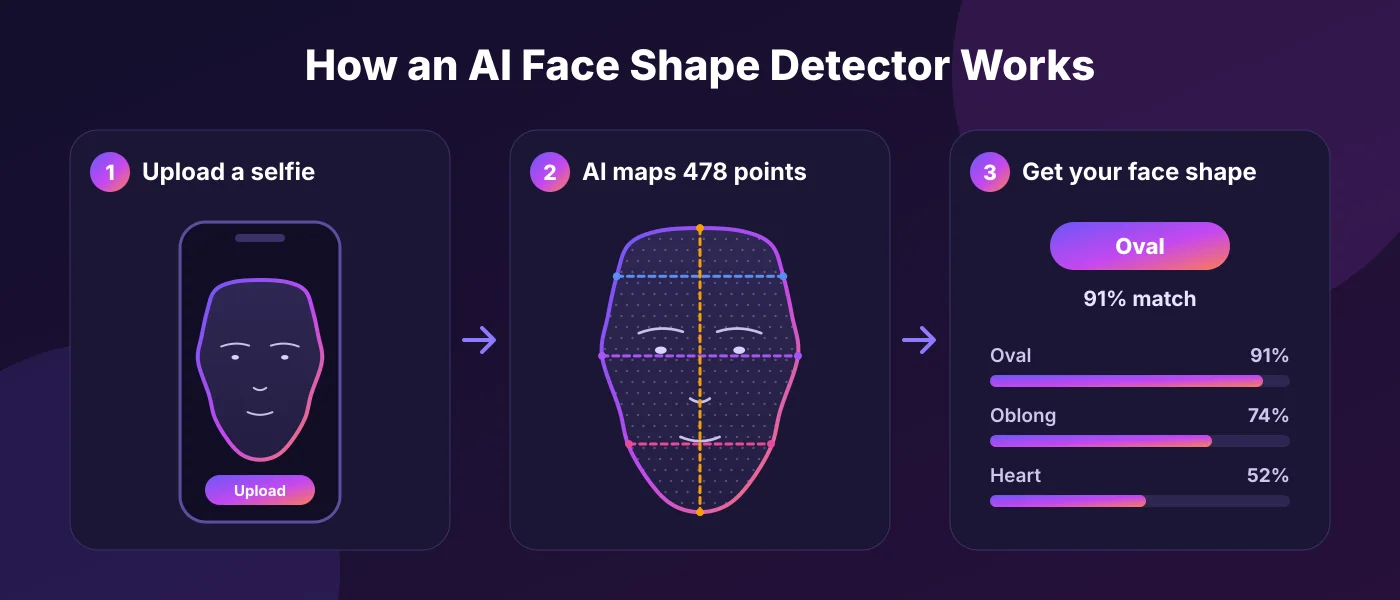
The fastest way to answer “what is my face shape?” is an AI face shape test. Instead of judging by eye, it measures your face from a single photo, so the answer takes about a minute.
Upload a selfie or take a photo
Use a recent, front-facing photo, or take one with your camera.
Let the AI measure your face
It maps 478 points on your face and measures your forehead, cheekbones, jaw and face length.
Read your result
You see your face shape, a confidence score and how closely you match each of the other seven shapes.
It is also the most consistent method. A tape measure is easy to hold at a slight angle and a mirror outline shifts when you move, but the AI takes every measurement from the same photo in the same way. You can try our free AI face shape detector: there is no sign-up, and your photo is never stored.
Method 2: Measure Your Face With a Tape Measure
This is the classic way to work out your face shape at home. You need a soft tape measure (the kind used for sewing), a mirror and something to write with.
Step 1: Measure your forehead
Measure across the widest part of your forehead, from temple to temple. This is usually about halfway between your eyebrows and your hairline.
Step 2: Measure your cheekbones
Measure from the outer point of one cheekbone to the other, just below the outer corners of your eyes.
Step 3: Measure your jawline
Measure from the tip of your chin to the corner of your jaw below your ear, then double the number to get your full jaw width.
Step 4: Measure your face length
Measure from the center of your hairline straight down to the tip of your chin.
Step 5: Compare the numbers
Find your largest width, then compare your length with it:
- Length about equal to width: you are likely round (soft jaw) or square (angular jaw).
- Length clearly greater than width: look at oval, oblong or rectangle. Oval tapers to a rounded chin; oblong and rectangle stay about the same width all the way down.
- Forehead the widest: heart is your most likely match.
- Cheekbones widest, with a narrow forehead and jaw: that points to diamond.
- Jaw the widest: that points to triangle.
Method 3: Trace Your Face in a Mirror
No tape measure? A mirror and something washable will do.
- Stand at arm’s length from a mirror in good light, with your head level and your hair tied back.
- Trace the outline of your reflection from hairline to chin with a washable marker, an old lipstick or a bar of soap. Close one eye so the line does not shift as you move.
- Step back and look at the shape you drew.
How to read your outline
- Widest point: forehead means heart. Cheekbones mean oval, round or diamond. Jaw means triangle. Even all the way means square, oblong or rectangle.
- Jaw and chin: sharp corners suggest square or rectangle. A soft curve suggests round, oval or oblong. A narrow, pointed chin suggests heart or diamond.
The mirror method gives you a rough idea, but it is the least precise: even a small head movement changes the outline.
Method 4: The 30-Second Visual Check
Look straight into a mirror, or at a front-facing photo, and ask yourself four questions:
- Is my face longer than it is wide? If not, you are probably round or square.
- Which part looks widest: forehead, cheekbones or jaw?
- Is my jawline soft or angular?
- Is my chin rounded, square or pointed?
Match your answers to the chart above. It is quick, but hairstyles, beards and lighting easily fool the eye, so treat it as a first guess and confirm it with Method 1 or Method 2.
Common Mistakes That Give the Wrong Face Shape
Most wrong answers come from the photo or the measuring, not from your face.
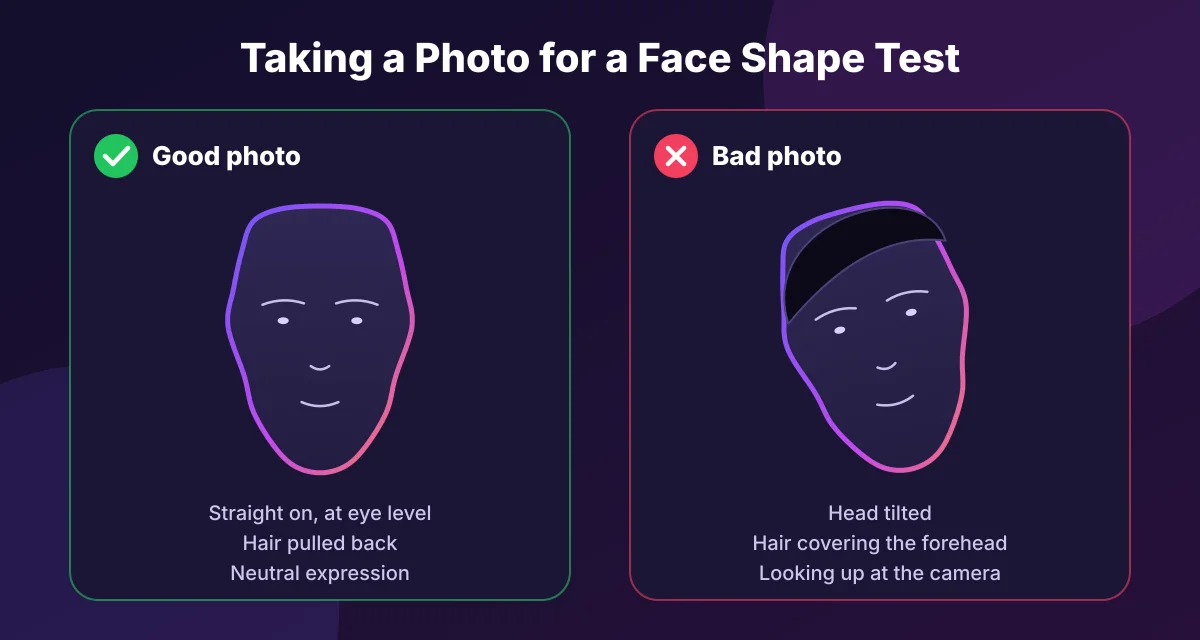
- Leaving hair over your face. Bangs and loose hair hide your forehead and jaw, two of the four key measurements.
- Tilting your head or camera. Looking up makes your jaw look wider; looking down makes your forehead look bigger.
- Taking the selfie too close. A phone held close to your face stretches your features. Hold it at arm’s length or use the rear camera.
- Smiling. A smile widens your cheeks and changes your jawline.
- Counting your beard as your jawline. A beard can make a round face look square. Measure the jaw bone, not the beard.
- Judging by one feature. A pointed chin alone does not make you heart-shaped; what counts is the combination of all four measurements.
What Is My Face Shape If I Match Two Shapes?
That is completely normal. Most people do not fit one shape perfectly, and common mixes are oval and oblong, round and square, and heart and diamond.
- Pick the shape with the higher score as your main shape.
- Use style tips from both, because advice that suits one usually suits the other.
- Test again with a new photo in better light. If the same two shapes keep coming up, you are a combination.
Can Your Face Shape Change?
Your bone structure stays the same in adulthood, but how your face looks can change:
- Weight gain or loss adds or removes fullness in the cheeks and jaw, so a face can look rounder or more angular.
- Aging softens the jawline over time.
- Beards, hairstyles and makeup can make your face look like a different shape without changing it.
If your weight or style has changed a lot, it is worth checking your face shape again.
I Know My Face Shape. What Next?
Your face shape is the starting point for choosing styles that balance your features. The general rule is contrast:
- Round and square faces suit styles that add height and length.
- Long faces (oblong and rectangle) suit styles that add width.
- Angular faces (square, rectangle and diamond) look softer with curves and texture.
- Soft faces (round and oval) get definition from angles and structure.
For example, if you have a round face, our round face shape guide lists the haircuts, glasses and beard styles that add length and definition.
What Is My Face Shape? FAQs
What is my face shape if my face is as wide as it is long?
You are most likely round or square. If your jawline is soft and curved, you are round; if it is strong and angular, you are square.
What is the most accurate way to find my face shape?
An AI face shape test is the most consistent, because it measures your forehead, cheekbones, jaw and face length from the same photo. Manual methods work too, but small measuring errors can change the result.
How do I know my face shape from a photo?
Use a front-facing photo taken at eye level, with your hair pulled back and a neutral expression. Then check which part of your face is widest and how long your face is compared with its width, or upload the photo to an AI face shape detector.
Can I find my face shape without a tape measure?
Yes. Use an AI test with a selfie, or trace your outline in a mirror with a washable marker or lipstick.
What are the 8 face shapes?
Oval, round, square, heart, triangle, diamond, oblong and rectangle. Each is defined by which part of the face is widest, how long the face is compared with its width, and the shape of the jawline and chin.
Do men and women have the same face shapes?
Yes. The same eight face shapes apply to everyone. Men’s faces often have a stronger jaw, so square, rectangle and triangle are common among men, but any shape is possible for anyone.
Why do face shape tests give me different results?
Usually because of the photo: a head tilt, a camera held too close, hair over the forehead or uneven lighting. Retake the photo straight on, at eye level and in even light, and the result will be more consistent.
So, What Is My Face Shape?
Your face shape comes down to four measurements and one question: which part of your face is widest? Measuring by hand works, but the quickest way to get a reliable answer is to find your face shape with AI from a single selfie, then use it to choose the haircuts, glasses and styles that suit you.