If you have ever typed “what face shape do I have?” into a search bar, you have probably found an AI face shape detector that promises an answer in seconds. But can a face scanner really tell your face shape better than a mirror and a tape measure? The short answer is yes, with a catch. In this guide, you will learn how these tools work, how accurate they really are, what makes them get it wrong and, most importantly, how to get a result you can trust.
How AI Face Shape Detectors Work
Every face shape detector, whether it calls itself a face shape analyzer, a face shape finder or an AI face analyzer, follows the same three steps:
- Find the face. First, the AI locates your face in the photo and ignores the background.
- Map the landmarks. Next, it places points on key features: the hairline, brows, cheekbones, jaw and chin. Our detector, for example, maps 478 facial landmarks.
- Measure and match. Finally, it measures your forehead width, cheekbone width, jaw width and face length, compares the ratios and matches them to the types of face shapes: oval, round, square, heart, triangle, diamond, oblong and rectangle.
In practice, you will meet two kinds of tools. Landmark-based detectors measure your facial structure directly and apply clear rules to the numbers. Image classifiers, on the other hand, learn from thousands of photos that people have labeled with a face shape, so they copy those people’s judgment, including their mistakes. Both can work well, but landmark-based tools are easier to check, because you can see what they measured.
So, How Accurate Are AI Face Shape Detectors?
To answer honestly, you need to split accuracy into two parts.
1. Measuring your face: very reliable
Modern face analysis models find facial landmarks precisely in clear, front-facing photos. As a result, a good detector gives you nearly the same measurements every time you upload the same photo. That is something a tape measure, held by hand, rarely manages.
2. Naming your face shape: naturally uncertain
The label is harder, and not because of the AI. There is no official, scientific definition of an oval or an oblong face. Each face shape chart draws the lines a little differently, and even stylists often disagree about the same person. On top of that, real faces rarely match one shape perfectly: many people sit between oval and oblong, round and square, or heart and diamond.
For the same reason, you should be wary of any website that claims a precise accuracy figure such as “99% accurate”. No independent benchmark exists for face shape detectors, so a number like that cannot be checked. In short, a detector can measure you accurately and still face a close call when it chooses one name for your face structure.
What Affects Face Shape Detector Accuracy
Most wrong results come from the photo, not the AI. These six problems cause the biggest errors:
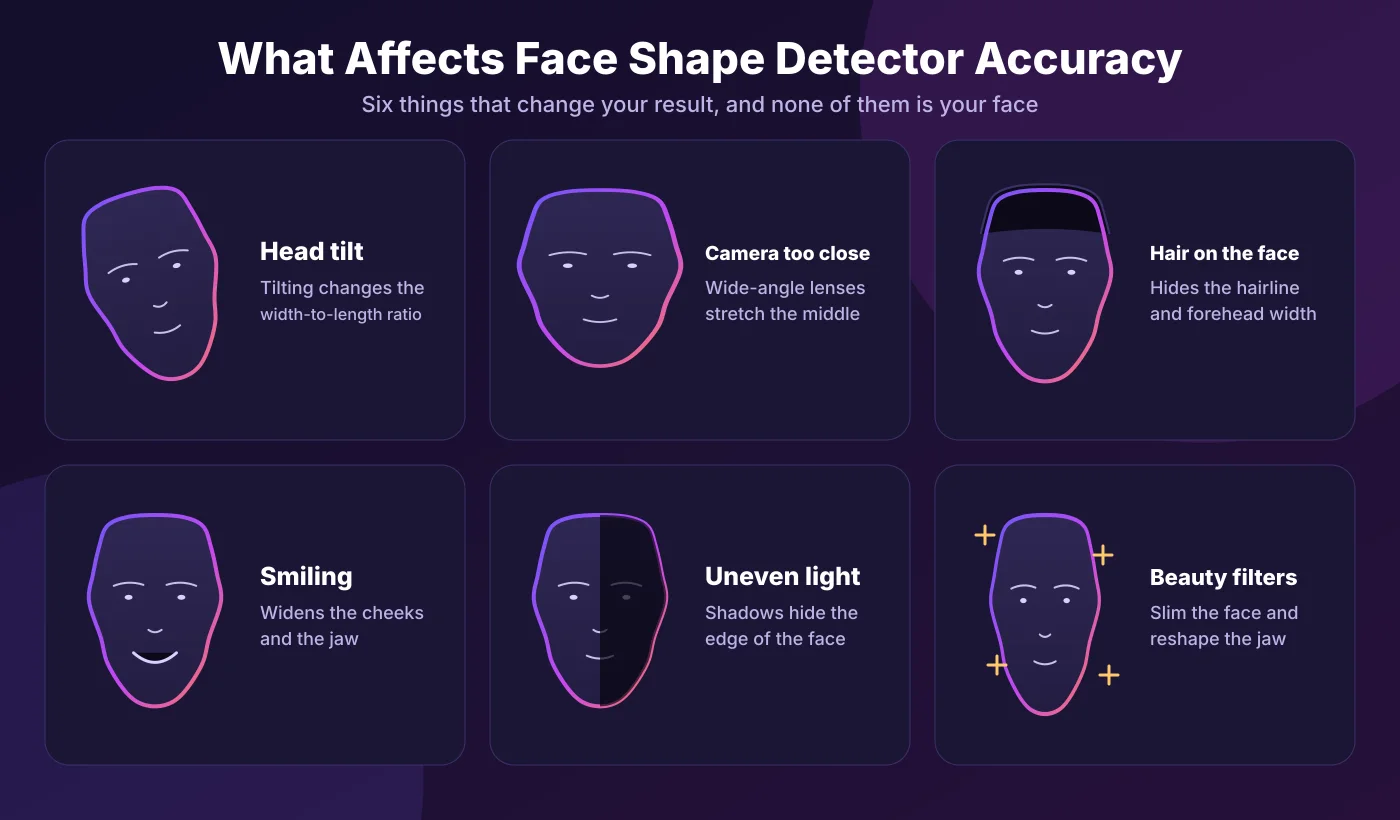
- Head tilt: tilting your chin up makes the jaw look wider and the face shorter, while tilting down does the opposite.
- Camera too close: phone cameras use wide-angle lenses, so a selfie taken close up stretches the middle of the face and shrinks the sides.
- Hair on the face: bangs hide the hairline and forehead width, which are two of the four key measurements.
- Smiling: a big smile widens the cheeks and changes the jawline.
- Uneven light: strong shadows hide the edge of the face, so the AI cannot see where your jaw ends.
- Beauty filters: filters slim the face and reshape the jaw, so the AI measures the filter, not you.
Glasses and beards matter too. Thick frames can hide the brow line, and a full beard can make a round jaw look square. If possible, take off your glasses and measure your jaw bone rather than your beard.
AI Face Shape Detector vs Other Methods
An AI detector is only one way to determine your face shape. Here is how the main methods usually compare.
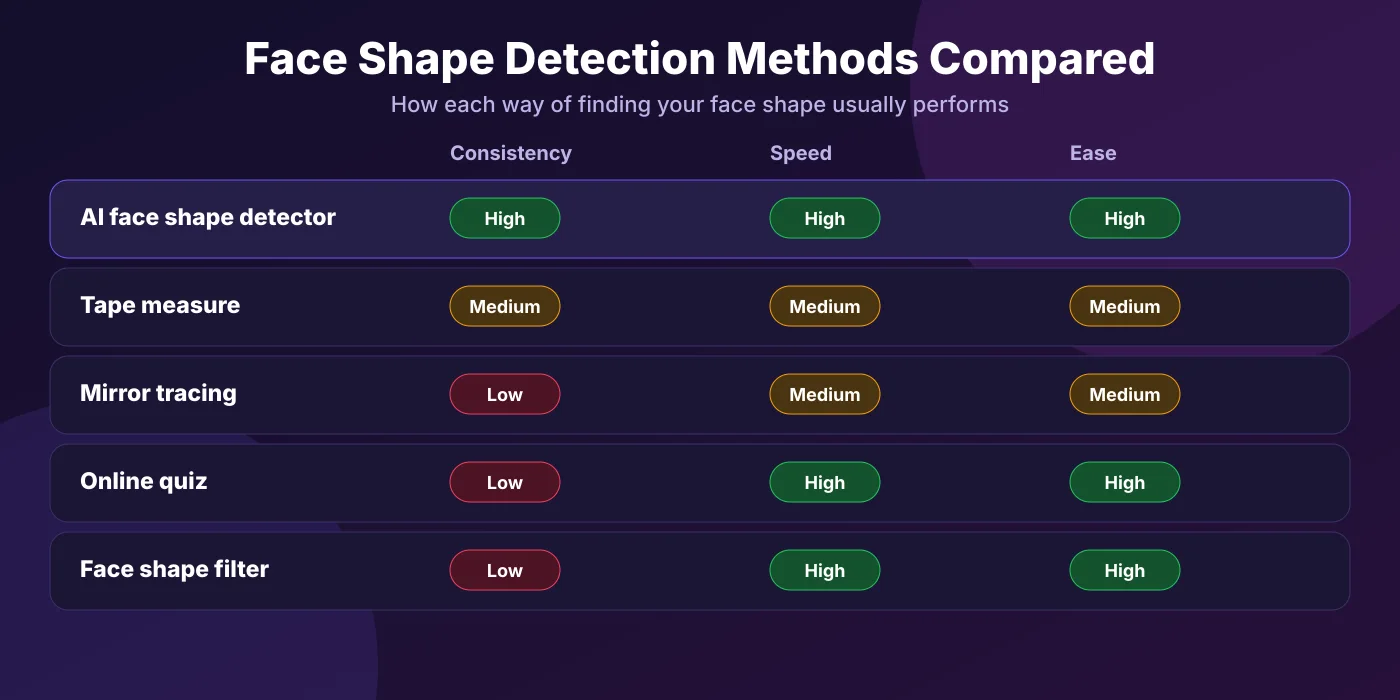
| Method | How it works | Main weakness |
|---|---|---|
| AI face shape detector | Measures landmarks on your photo and compares the ratios | Depends on a good, straight-on photo |
| Face shape calculator | You type in your own measurements and it applies the rules | Only as good as your tape measure work |
| Tape measure | You measure four widths and lengths by hand | Easy to hold the tape at an angle |
| Mirror tracing | You trace your outline on the mirror | The line shifts as soon as you move |
| Online quiz | You answer questions about your own face | Relies on how you see yourself |
| Face shape filter | An app effect overlays a shape on your camera view | Built for fun, not measurement |
A face shape filter on social media deserves a special warning. These filters look like a quick test, but most of them simply cycle through shapes or overlay an outline without measuring anything, so treat them as entertainment. Likewise, a “what is my face shape” app is only as good as the analysis behind it, so check whether it shows its measurements before you trust it.
If you would like to cross-check by hand, our guide on how to find your face shape walks you through the tape measure and mirror methods step by step.
How to Read a Face Shape Confidence Score
A good face analyzer does not stop at one word. Instead, it shows a confidence score for your top shape and how closely you match the others. Reading those numbers tells you far more than the label alone.
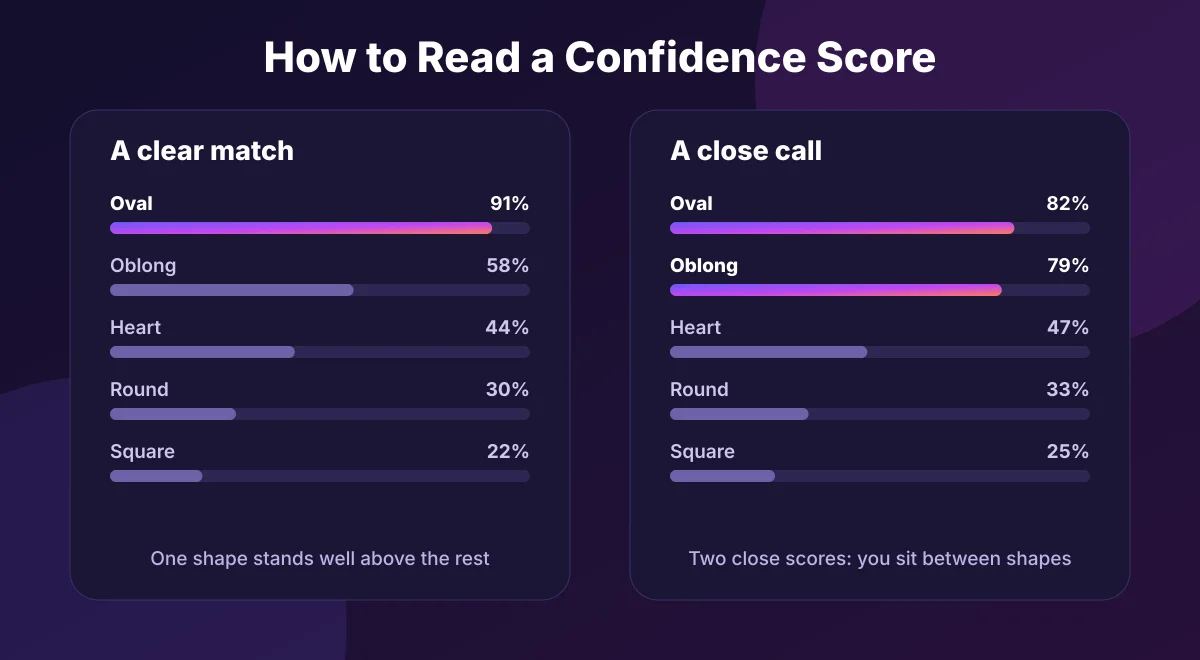
- One shape far ahead: you have a clear match. Use that shape’s style advice with confidence.
- Two shapes close together: you sit between them. That is not an error; it is the most honest answer for many faces. Use your top shape as the main one and borrow tips from the second.
- Several shapes close together: the photo may be the problem. Retake it following the checklist below and compare the results.
If you want to see what each shape looks like, our face shape chart explains all eight types of face shapes side by side.
How to Get the Most Accurate Result
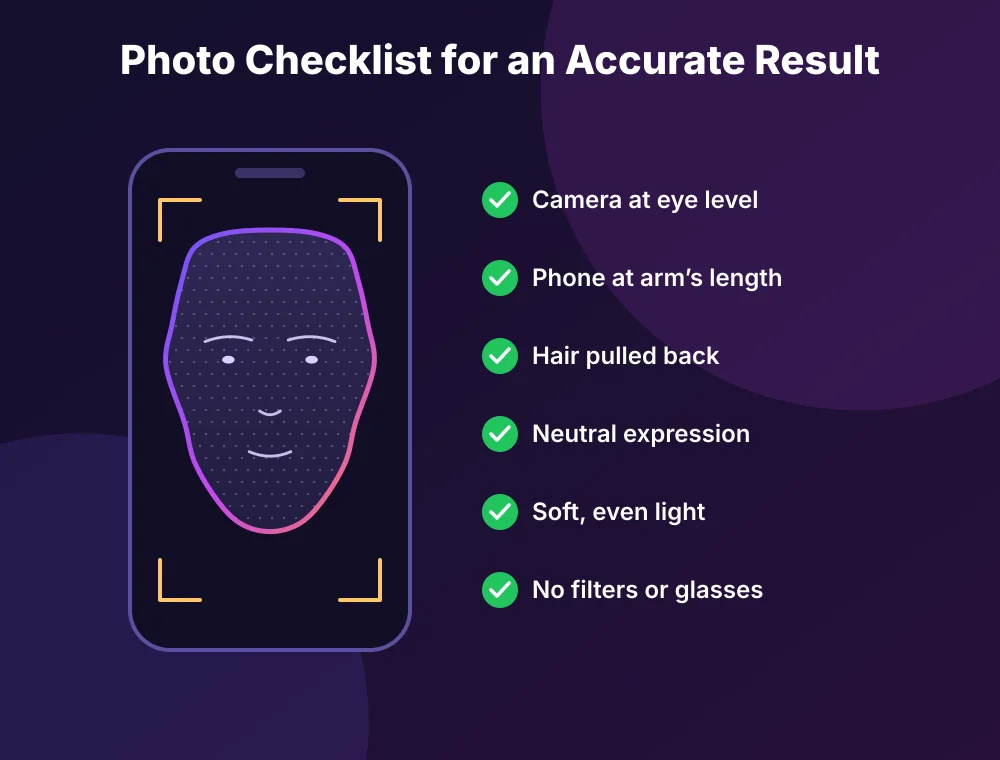
The photo decides most of the accuracy. Follow these steps and almost any good detector will give you a reliable answer.
Hold the camera at eye level
Keep the phone straight in front of your face, not above or below it.
Stand at arm’s length
A little distance reduces lens distortion. If you can, use the rear camera or ask someone to take the photo.
Pull your hair back
Show your whole hairline, forehead and jaw.
Keep a neutral expression
Relax your face and close your mouth; save the smile for later.
Use soft, even light
Face a window or a lamp so both sides of your face are lit evenly.
Skip filters and glasses
Turn off beauty mode and remove glasses so the AI sees your real face structure.
How to Test Whether a Face Shape Detector Is Accurate
You do not need to take accuracy on trust. Instead, run this quick test on any tool:
- Upload three photos taken a minute apart, all following the checklist above.
- Compare the results. A reliable detector gives the same top shape, or the same two close shapes, every time.
- Check the explanation. The best tools show what they measured, such as your forehead, cheekbones and jaw, so you can see why they chose a shape.
- Cross-check by hand. Measure your face with a tape measure once. If the AI and your measurements point to the same shape or the same pair of shapes, you can trust the answer.
Red flags to watch for
- The tool gives a different shape almost every time.
- It never shows a confidence score or your other close matches.
- It claims an exact accuracy percentage with no explanation.
- It asks you to pay or sign up before you see any result.
- It does not say what happens to your photo.
What an AI Face Shape Detector Cannot Tell You
- Whether your face is attractive: face shape describes proportions, not beauty. Every shape can look great.
- Anything medical: a face shape detector is a style tool. It cannot assess your bones, teeth or health.
- Your head shape: face shape covers the front of your face, from hairline to chin, while head shape describes your whole skull.
- How your face will change: weight, age and hairstyles change how your face looks over time, so it is worth checking again after a big change.
Is It Safe to Upload Your Photo?
Accuracy is not the only thing to check. Before you upload a selfie to any face scanner, look for a clear privacy statement that says where the analysis happens and whether the photo is stored.
Our detector, for instance, maps your face directly in your browser and does not store your photo. The optional AI precision check is off by default; if you turn it on, it analyzes a small cropped copy without keeping it. You can read exactly how it works in our privacy policy.
AI Face Shape Detector FAQs
Are AI face shape detectors accurate?
Yes, for measuring your face, as long as the photo is straight-on, well lit and taken from arm’s length. Choosing one label is less certain, because many faces sit between two shapes, so the best detectors show a confidence score and your other close matches.
Why did I get different face shapes from different photos?
Usually the photo changed, not your face. A head tilt, a close-up selfie, hair over the forehead, a smile or a filter can all shift the result. Retake the photo straight on, at eye level and in even light, and compare again.
What face shape am I if two shapes score almost the same?
You sit between those two shapes, which is very common. Treat the higher score as your main shape and use style tips from both.
Is a face shape calculator more accurate than AI?
A face shape calculator applies the same kind of rules, but it relies on measurements you take by hand, which are easy to get slightly wrong. An AI face shape detector measures from the photo, so it is usually more consistent.
Do face shape filters show your real face shape?
Usually not. Most face shape filters on social media are effects built for fun; many do not measure your face at all. Use a real face shape detector or a tape measure instead.
Can an AI face shape detector work with a beard or glasses?
It can, but the result may shift. A full beard can make the jaw look wider or squarer, and thick frames can hide the brow line, so remove glasses and keep in mind that the AI measures what it can see.
Is a what is my face shape app better than an online tool?
Not necessarily. Apps and websites can use the same technology. What matters is whether the tool shows its measurements, gives a confidence score and explains what happens to your photo.
The Bottom Line
So, how accurate are AI face shape detectors? Accurate enough to trust, as long as you give them a good photo and read the whole result, not just the label. A good detector measures your face more consistently than a tape measure, and an honest one shows you when your face sits between two shapes. To see it for yourself, follow the photo checklist and try our free Face Shape Detector.