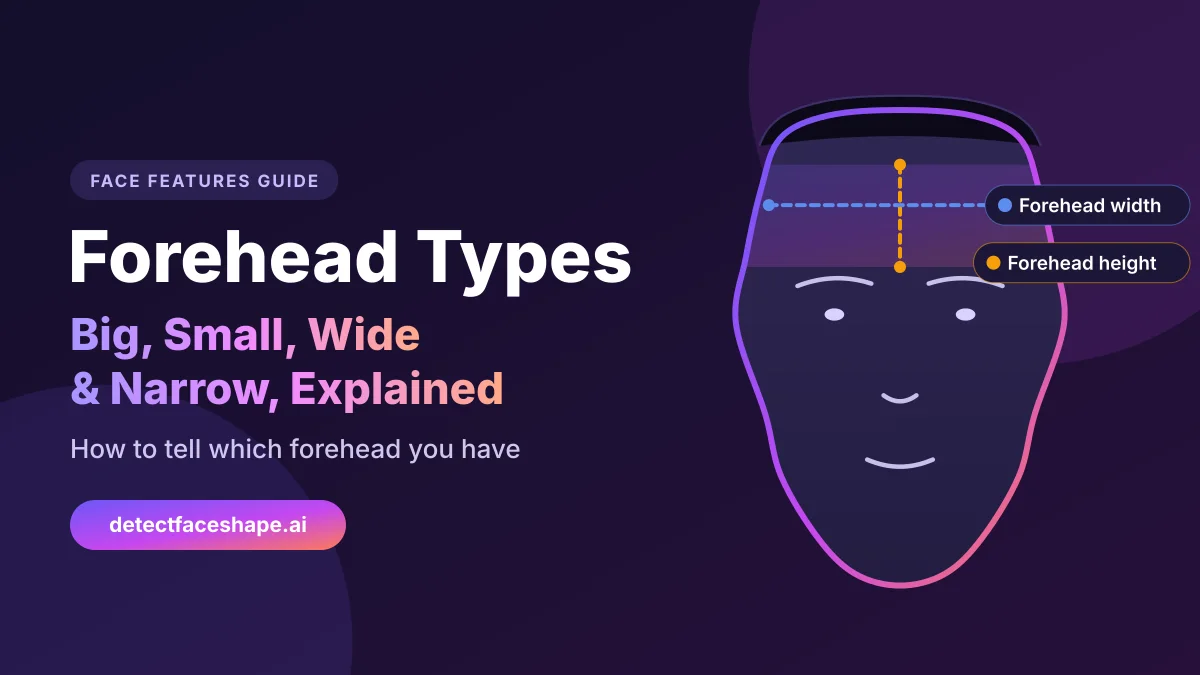
Your forehead is the upper part of your face, from your hairline down to your brows. It is the first thing people see above your eyes, and its size and shape decide whether a fringe, a high ponytail or a pair of browline glasses will look balanced on you. This guide explains the four forehead types, how to measure yours, how your hairline shapes it, and the styles that suit each type.
What Counts as Your Forehead?
Your forehead runs from your hairline down to your brow ridge, the bony ridge just above your eyebrows, and across from temple to temple. It sits over the frontal bone of the skull, so its basic shape comes from bone, while the hairline decides where it visibly starts.
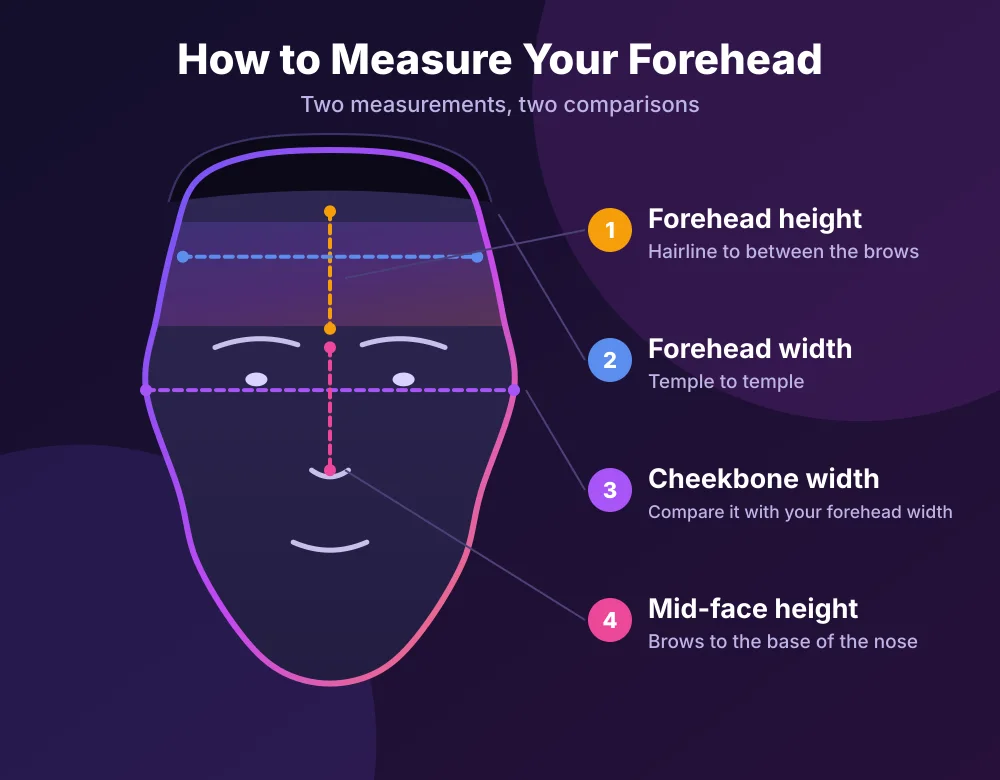
Two measurements describe it:
- Forehead height: from the center of your hairline to the point between your eyebrows.
- Forehead width: across the widest part of your forehead, from temple to temple.
Artists often split the face into three horizontal parts of roughly equal height: hairline to brows, brows to the base of the nose, and nose to chin. This “rule of thirds” is a drawing guideline, not a medical standard, but it is a handy way to judge whether your forehead looks tall or short.
The 4 Main Forehead Types
Two of the forehead types describe height and two describe width, so you will usually match one of each.
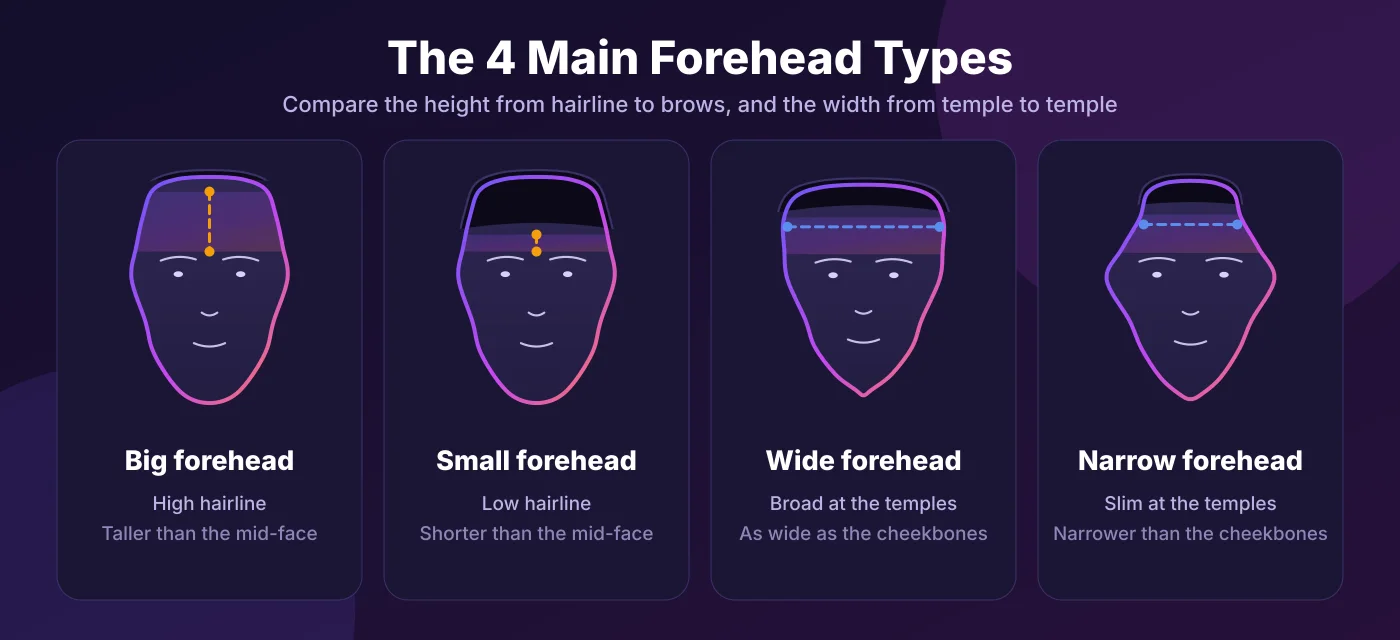
Big forehead (high forehead)
A big forehead has a high hairline, so the space from hairline to brows is noticeably taller than the middle of your face. It is often called a high forehead, and it can make the face look longer. Big foreheads are common with oblong and oval face shapes, and they become more frequent with age as hairlines move back.
Small forehead (low forehead)
A small forehead has a low hairline, so the upper part of the face is shorter than the middle part. It puts more visual weight on the eyes, cheeks and jaw, and it can make a face look rounder or wider. Small foreheads are common with round and square faces.
Wide forehead
A wide forehead is broad at the temples, about as wide as your cheekbones or wider. A forehead that is clearly the widest part of the face is the mark of a heart face shape, and wide foreheads are also typical of square and rectangle faces.
Narrow forehead
A narrow forehead is slim at the temples and clearly narrower than the cheekbones. It is typical of diamond and triangle faces, where the widest point sits lower down, at the cheekbones or the jaw.
Forehead Shapes: Hairlines and Profiles
Beyond size, two details shape how a forehead looks.
Hairline shape
- Straight hairline: an even line across the top, which makes the forehead look broad and square.
- Rounded (bell-shaped) hairline: a soft arch that frames the face and makes the forehead look smaller.
- Widow’s peak: a V-shaped point in the middle of the hairline, often seen with heart-shaped faces.
- M-shaped hairline: higher at both temples than in the center, common in men and often a sign of a hairline that is starting to recede.
Forehead profile
Seen from the side, a forehead can be flat (fairly vertical), rounded (curving forward) or sloping (leaning back toward the hairline). A sloping forehead often looks smaller from the front, while a rounded one can look fuller and taller.
How to Tell Your Forehead Type
You need a mirror or a straight-on photo, a soft tape measure or a ruler, and two minutes. Pull your hair back so you can see your whole hairline.
Measure your forehead height
Measure from the center of your hairline straight down to the point between your eyebrows.
Measure your mid-face
Measure from the point between your eyebrows down to the base of your nose.
Compare the two heights
If your forehead is clearly taller than your mid-face, you have a big forehead. If it is clearly shorter, you have a small forehead. About equal is average.
Measure your forehead width
Measure across the widest part of your forehead, from temple to temple.
Compare it with your cheekbones
Measure across your cheekbones. A forehead about as wide or wider is wide; one clearly narrower is narrow.
Your forehead width is one of the four measurements that decide your face shape, together with your cheekbones, jaw and face length. If you have not found yours yet, our guide What Is My Face Shape? walks you through it.
Forehead Types and Face Shapes
Each face shape tends to come with a typical forehead:
| Face shape | Typical forehead width | Typical forehead height |
|---|---|---|
| Oval | Slightly wider than the jaw | Average to high |
| Round | Medium, with a rounded hairline | Often small |
| Square | Wide, close to the jaw width | Average to small |
| Heart | Wide, the widest part of the face | Average to high, sometimes with a widow’s peak |
| Triangle | Narrow, the slimmest part of the face | Average |
| Diamond | Narrow | Average |
| Oblong | Similar to the cheekbones | Often high |
| Rectangle | Wide, similar to the jaw | Often high |
These are typical pairings, not rules: any face shape can have a big or a small forehead.
What Changes the Size of Your Forehead?
The bone under your forehead does not change in adulthood, but the visible forehead can:
- A receding hairline: the most common reason a forehead grows. Hairlines naturally move back with age, and male and female pattern hair loss can raise the hairline further.
- Hairstyles: tight ponytails, slicked-back styles and center parts show the whole forehead, while bangs and side parts hide part of it.
- Brow position: brows sit a little lower with age, which can make the forehead look taller.
- Lighting and camera angle: looking down at a phone camera makes the forehead look bigger in photos.
If your hairline is moving back quickly, or you notice patches of hair loss, it is worth talking to a doctor or dermatologist.
Is a Big Forehead Attractive?
Yes, a big forehead can be very attractive. Plenty of models and actors have high foreheads, and a tall forehead is often seen as elegant. What people notice is balance, not size: a forehead in proportion with your eyes, nose and chin looks harmonious, whether it is big or small.
You may also hear that a big forehead is a sign of intelligence. That is folklore from face reading, and there is no scientific evidence for it.
Best Hairstyles and Glasses for Each Forehead Type
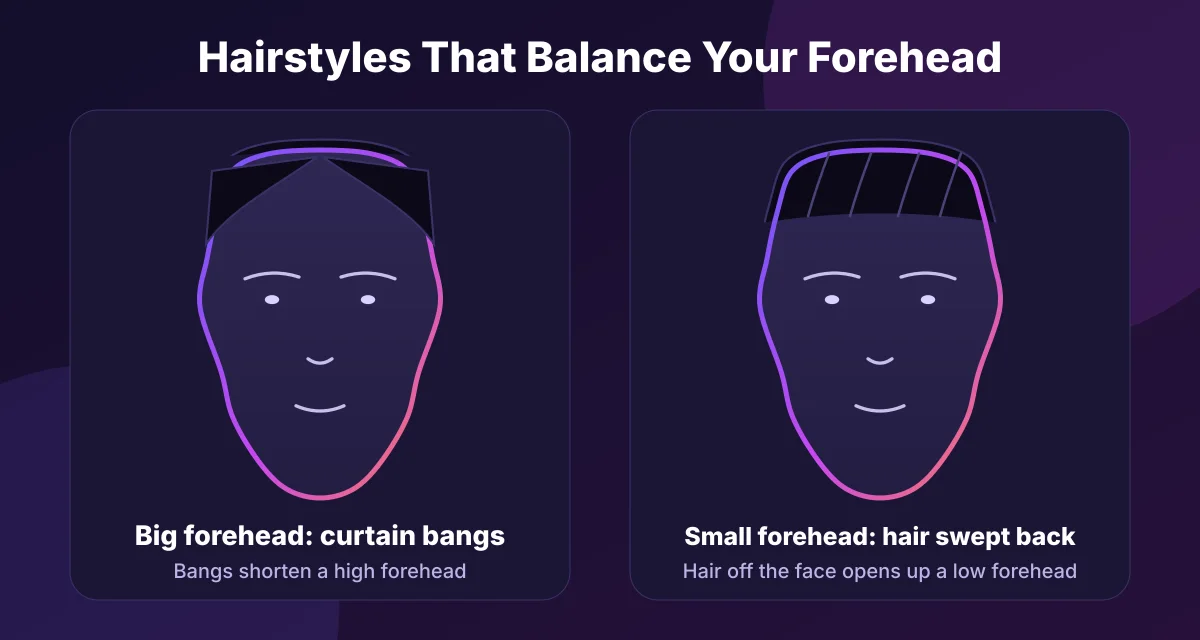
The aim is the same as with any feature: balance it. Cover or soften a big or wide forehead, and open up a small or narrow one.
| Forehead type | Hairstyles | Men’s haircuts | Glasses | Makeup |
|---|---|---|---|---|
| Big | Curtain, side-swept or blunt bangs; side parts; volume at the sides | A fringe, textured crop or French crop | Bold or browline frames that add weight across the brows | Bronzer along the hairline to shorten the forehead |
| Small | Hair swept back or up, high ponytails, no heavy bangs | Slicked back, quiff or pompadour, short buzz cut | Thin or rimless frames that keep the brow area light | Highlighter in the center of the forehead |
| Wide | Side-swept bangs, layers that frame the face, volume at the jaw | Longer sides and a side part | Frames wider at the bottom, such as aviators | Contour at the temples |
| Narrow | Volume at the temples, soft waves, side parts | Fuller sides, avoid very tight fades | Browline and cat-eye frames that widen the top of the face | Highlighter at the temples |
How to hide a big forehead without bangs
- Use a deep side part, which lets hair fall across part of the forehead.
- Add volume at the sides rather than on top, so the face looks wider and shorter.
- Leave a few face-framing pieces loose at the front instead of pulling everything back.
- Choose bold brows and frames to draw the eye down to the middle of the face.
Forehead Types FAQs
What is considered a big forehead?
A forehead is usually called big, or high, when the distance from your hairline to your brows is clearly taller than the distance from your brows to the base of your nose. There is no fixed measurement in centimeters, because it depends on the size of the rest of your face.
What is a “fivehead”?
It is a playful slang word for a big forehead: a pun on “forehead” suggesting it is so big it should be called a “five-head”. It simply means a high hairline.
Can your forehead get bigger?
The bone does not grow in adulthood, but your forehead can look bigger as your hairline recedes with age or hair loss. Brows sitting slightly lower with age can also make it look taller.
Is forehead size genetic?
Mostly, yes. Your bone structure and the height and shape of your hairline are largely inherited, which is why foreheads often look alike within families.
Do bangs suit a small forehead?
Heavy, full bangs usually make a small forehead look even shorter. Light, wispy bangs or hair swept to the side work better, or you can show your whole forehead with hair pulled back.
Which face shape has a wide forehead?
Heart faces have the widest foreheads, since the forehead is the broadest part of the face. Square and rectangle faces also tend to have wide foreheads.
Which Forehead Type Do You Have?
Big or small, wide or narrow: your forehead type comes down to its height compared with your mid-face and its width compared with your cheekbones. None is better than another; the right haircut, bangs or glasses simply bring it into balance with the rest of your face. Your forehead width also shapes your overall face shape, so for the full picture, check your face shape with our free Face Shape Detector.